

Why You Listen to Taylor Swift (And Why You Buy Those Jeans)
Marina Bianchi's economics theory explains Taylor Swift's dominance—and your own consumption choices.

If you enjoy this newsletter, if you talk about it with friends, if it encourages you to explore uncharted territory, please consider subscribing.
Last week, we explored phantom copies, and I promised to explain how “characteristics theory” explains Taylor Swift’s chart dominance. Today, we learn why being unoriginal is a good thing if you’re an artist, and a cultural economist helps us understand how Swift’s songs wind up in all your playlists.
A traditional economist would predict that the artist who creates the most original work will dominate streaming. Traditional economic theory assumes the “best” product wins in a free market, and we tend to assume “best” means “most original,” so it follows that the most original artist should get the most streams, right?
Nope. In reality, streaming success depends more on factors like marketing, algorithmic playlists, and listener habits than pure originality. Also, what is deemed “best” is rarely the most original in art, music, film, or literature.
Marina Bianchi, Professor of Economics at the University of Cassino, would predict something different from her peers. She’d predict that the artist who 1) most skillfully combines the novel and the familiar, 2) best coordinates fan consumption of her work, and 3) tirelessly builds her audience’s ability to appreciate her work will dominate streaming.
Obviously, that’s Taylor Swift.
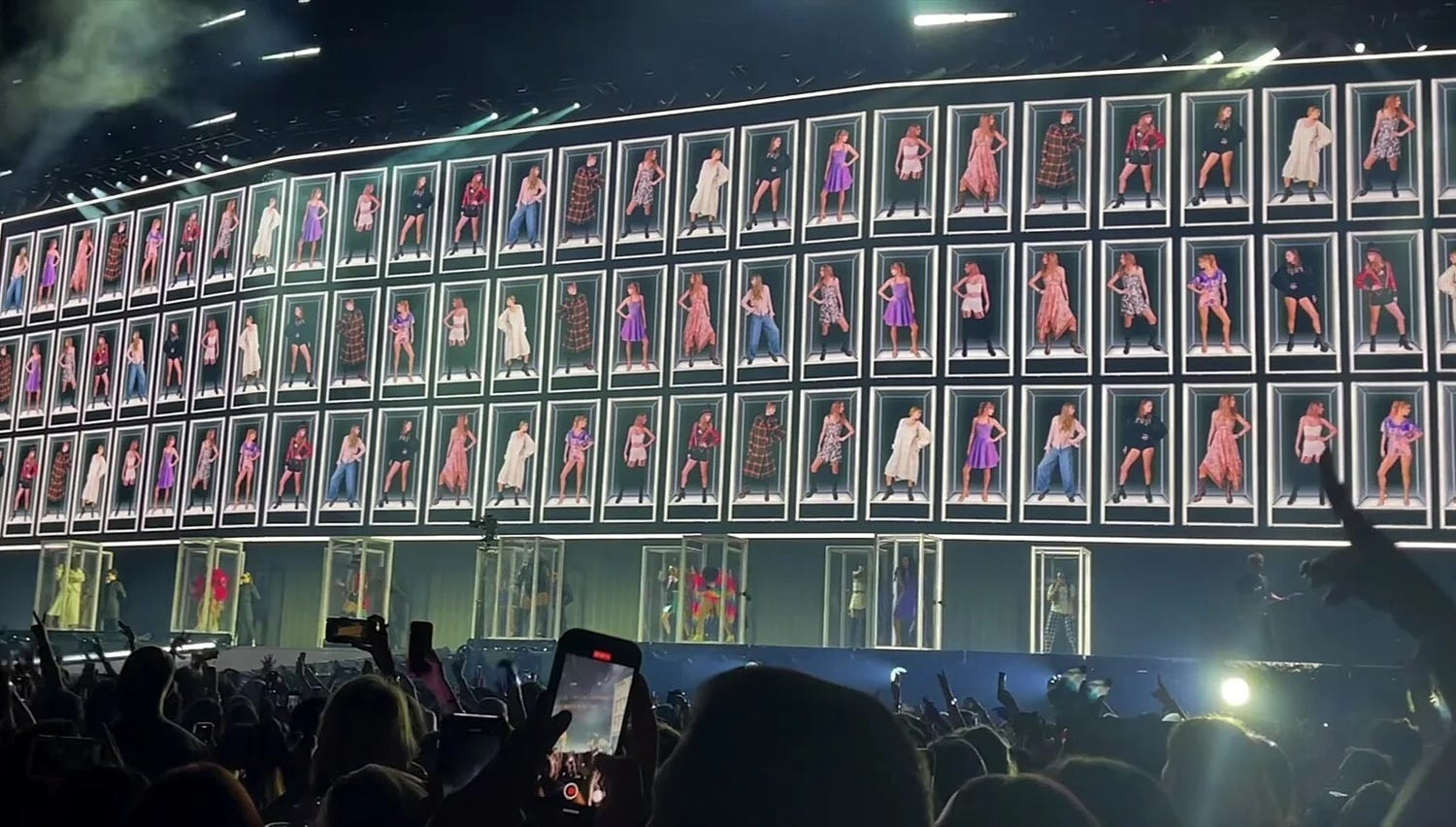
This takes us back into my personal zone of genius: women’s underrecognized intellectual property. Marina Bianchi’s work gives us the tools to understand why Taylor Swift dominates streaming in ways that make no sense to people who don’t understand cultural economics. Once you understand Bianchi’s theories, you’ll never hear Taylor Swift’s music the same way again. Also, you’ll never buy jeans, select a pint of ice cream, or order your ninth pair of Rothy’s without knowing why you make your choices.1
To understand Bianchi’s theories, we need a quick primer on cultural economics.
Cultural Economics 101
Cultural economists explain how people derive satisfaction from goods like music, art, literature, fashion, and media, whose value lies not in functional efficiency but in their capacity to provide novelty, complexity, and meaning.
Kelvin Lancaster showed that consumers don’t buy things; they buy characteristics. You don’t actually want “orange juice”—you want Vitamin C, citrus flavor, the refreshing feeling it gives you, and maybe a hit of childhood nostalgia. We can predict consumer demand by analyzing goods as bundles of characteristics.2
Gary Becker established that consumers are active producers. We purchase goods and services to create our own “commodities”—the things we actually desire.3 If the commodity is “emotional experience” or “identity formation,” a consumer might get a Spotify account and listen to songs made by a certain musician with emotionally resonant lyrics and a robust fanbase.
Tibor Scitovsky distinguished between comfort and pleasure.4 Comfort merely eliminates negative states, but pleasure creates positive states. Pleasure requires complexity and “consumption skills”—you’ve got to know a bit about what you’re consuming in order to enjoy it. Songs that provide pleasure contain renewable complexity, enable collective interpretation, and create intertextual networks. These features are hallmarks of Taylor Swift’s catalog.
Marina Bianchi bridges these observations, but adds her own unique insights. Traditional economics treats consumers as passive responders, but Bianchi argues that consumers are active agents who seek out, create, and shape novelty in consumption. Her work perfectly predicts why the artist who 1) most successfully bundles characteristics, 2) enables production of the most useful Becker commodities, and 3) drives the most pleasure will dominate a streaming environment where algorithms match characteristic bundles to user preferences.5
Let’s put all that together.
Lancaster, Scitovsky, and Becker built a map of consumption habits—a “space” exploited by algorithms. Bianchi explained the dynamics of how consumers and artists move through this space, creating value through the pleasure of novelty and discovery. Taylor Swift is the artist who most successfully navigates this space, using recognizability (a sonic anchor) and novelty (a sonic vehicle) to move strategically and efficiently.
Why Swift Dominates: The Bianchi Analysis
Swift doesn’t write the most musically innovative songs. That’s not a dig; Peter Paul Rubens, Andy Warhol, and Pablo Picasso weren’t the most innovative artists, either. When something is too original, no one actually likes it.
This is what the most successful artists do brilliantly:
Recombine familiar characteristics in novel ways
Require audiences to build “consumption skills” to appreciate their work
Create fashion cycles of novelty and saturation
Facilitate coordinated fan consumption
Reward collecting behaviors
Maintain catalog relevance through intertemporal strategies
Let me explain what all of that actually means.
Characteristics as Cognitive Keys
Bianchi shows that users don’t actually prefer the original—they prefer variations on it. She writes:
“Thinking, in Lancastrian fashion, of goods as combinations of characteristics, allows us to use characteristics as cognitive keys that can be transferred from one good to another, establishing similarities and differences…Characteristics and their combinatory order then operate as rules of recognition and classification any time a new good appears.”
Take “Wildest Dreams.” What’s the characteristic bundle that defines “Lana Del Rey-ness”?
Cinematic atmospherics
Nostalgic Americana
Sultry delivery
Slow-burn arrangements
Tragic romanticism
These characteristics can be transferred from one song to another—from one artist to another—and still act as cognitive keys that enable recognition.
Swift deploys a similar bundle—let’s call it [X’, Y’, Z’] where the primes indicate slight variations. You recognize it (”Hey, this sounds like Lana!”), but Swift’s voice + Swift’s narrative specificity + Swift’s production team = a new combinatory structure. The tension between “I know this” and “I’ve never heard this” creates pleasure, and new combinations of familiar characteristics create novelty within familiarity.
Why this drives streaming: Algorithms match characteristic bundles. A listener who likes Lana del Rey is recorded as desiring characteristics [X, Y, Z]. When Swift’s Lana-style tracks have vector [X’, Y’, Z’], the algorithm recognizes the related combinatory structure and recommends Swift. If the listener finds the Swift song familiar enough to enjoy immediately, yet novel enough to sustain interest, the algorithmic prediction is satisfied.
Novelty Through Recombination
Novelty is desirable, but consuming novelty destroys it. Once you’ve heard a “new” song, it’s no longer new, and its novelty is extinguished. This creates perpetual demand for fresh novelty—except characteristics don’t exist independently, they exist in combinatory structures. Change one element and you change the whole!
Bianchi uses examples: “Add a spice to a recipe and you risk altering the whole effect,” and “Add an Internet connection to an ordinary mobile phone and the whole concept of ‘telephone’ is altered.” Novelty comes from recombining existing characteristics in new patterns, not from adding new characteristics.
Pop music has a limited palette—roughly twelve notes, standard chord progressions, conventional song structures, established genres. Swift keeps the functional characteristics of her songs industry-standard (exceptional professional production, competent vocals, radio-friendly length) while varying formal characteristics to create novelty.

Swift doesn’t invent new musical characteristics. She recombines existing ones:
Album Characteristic Bundle Why It’s Novel
Fearless [Country + Pop + Teen Perspective] Genre fusion
1989 [Pop + 80s synth + Confessional] Lana-like, Carly Rae-like
folklore [Indie + Acoustic + Narrative] Bon Iver-ish, The National-ish
Midnights [Electronic + Pop + Maturity] Characteristic recombination
Listeners seeking “something new” get novelty in formal attributes while retaining comfort in functional attributes. You’re not shocked by a Swift song (there’s functional stability), but you’re intrigued by the new stylistic direction (there’s formal novelty). This is the sweet spot for streaming: familiar enough to trigger “play,” novel enough to trigger “replay”!
Style Migration as Strategic Navigation
Most artists occupy a fixed location in Lancaster’s characteristics space. They find their sound and stay there. Swift treats characteristics space like territory to be explored and conquered—that’s why I said she navigates like no other.
When Swift moves from country (Fearless) to pure pop (1989) to indie folk (folklore), she’s not abandoning previous positions—she’s expanding her total addressable market. Each style migration captures a new listener base while retaining previous fans. She makes genre-crossing safe because Swift-specific characteristics remain consistent across migrations.
The brilliance: every new style Swift explores creates new connections back to her existing catalog. When she releases folklore, it doesn’t just add indie folk tracks to her portfolio. It reframes her entire catalog through new characteristics. Red‘s “All Too Well” suddenly reveals indie sensibilities that were always there. 1989‘s “This Love” connects to folklore‘s atmospheric production. Style migration creates intertextual pathways that make the entire catalog more valuable—it’s multiplicative, not additive.
An easier way to understand:
Traditional Artist Path:
Release Album A in Genre X
Fans of Genre X stream it
Wait 3 years
Release Album B in Genre X
Same fans stream it
Old album streams decline
Swift’s Migration Path:
Release Lover in pop space → captures pop audience
Release folklore in indie space → captures indie audience
Indie fans discover Reputation through the catalog → new streams of old album
Pop fans discover folklore → new streams of new album
Both groups explore Red to find the transition point → catalog streams increase
Algorithms see cross-genre engagement → recommend across audience segments
The math: If you occupy one genre, you get streams from that genre. If you occupy five regions and create bridges between them, you get streams from five genres plus streams from people crossing the bridges plus algorithmic recommendations that span multiple audience segments.
Consumption Skills and Coordinated Novelty
Scitovsky showed that pleasure requires complexity and skill. Swift’s audience has sophisticated pop music consumption skills—they can identify chord progressions, recognize stylistic references, play Easter egg hunting games, understand lyrical storytelling conventions, and appreciate intertextuality.
People with higher consumption skills listen more frequently because they extract more value per listen. They stream the same song dozens of times because each listen reveals new layers. This is Bianchi’s “consumption skill” in action.
Swift has also mastered coordinated novelty consumption: the album drops at midnight → the Eras Tour creates a synchronized collective experience (whether in person, in a theater, or streaming) → social media drives coordinated listening → Easter eggs require collective decoding. A whole network is observing connections, but making new connections, too.
When consumption is coordinated, individual streaming decisions influence others: your friend streams the new album, you stream it, and the algorithm recommends it to your whole network. The network effect multiplies each streaming decision.
Dynamic Catalog Value
Here’s where it gets really interesting. Swift’s catalog functions as an ecosystem where each new release increases the value of the entire back catalog through newly revealed connections. folklore and evermore aren’t just two indie folk albums—they’re sequential (evermore builds on folklore’s aesthetic), complementary (listening to both creates a richer experience), and intertextual (songs reference each other across albums).
The value (pleasure) of “tolerate it” on evermore is higher if you’ve heard “the 1” on folklore because you understand thematic continuity. The whole catalog is worth more than the sum of individual albums because of these complementarities.
This explains Swift’s streaming dominance: most artists have declining catalog streams (old albums fade). Swift has increasing catalog streams because re-recordings make old songs “new” again, references to old work in new work drive people back to the catalog, and the “Eras” framework makes her entire back catalog relevant.
Fashion Cycles and Novelty Renewal
According to Bianchi, fashion involves coordinated group behavior that facilitates consumption and destroys novel content, creating demand for new fashions. Swift operates on fashion cycle logic: introduce new album (creating novelty) → fans coordinate around the “new” Swift sound → novelty gets consumed through repeated listening → market demands fresh novelty.
But Swift manufactures perpetual novelty cycles. Before listeners exhaust one characteristic bundle, she introduces a variation—new version of old song (Taylor’s Version), acoustic version, different production style, “from the vault” track. Each variation is novel enough to trigger new streaming while familiar enough to match listener preferences.
Let’s look at an example:
“All Too Well (10 Minute Version)”
According to traditional economics, there is no value in a 10-minute version of a 5-minute song. The novelty is exhausted, and all you’re delivering is more of the same. Bianchi would disagree:
“The human mind craves novelty, but not something so novel that it cannot make sense of it—the most pleasant experience is on the borderline with the unpleasant, differently placed for different people and shifting with changing circumstances.”
The original 5-minute version had these characteristics:
Narrative arc
Emotional intensity
Temporal progression
Emotional resolution
The 10-minute version has the same characteristics, but:
The extended bridge section changes the emotional trajectory
Additional verses alter the narrative interpretation
Increased length creates a new endurance characteristic
As a result, the entire song feels different, not just “longer.” Changing the combination of characteristics, and in a way that might be slightly unpleasant (demand for extended attention, thinking about Jake Gyllenhaal again), changed the whole character of the song for listeners. And that’s precisely what listeners wanted.
She Told You None of It Was Accidental
Taylor Swift dominates streaming not because she’s the most innovative or original artist. (I would say the same of Rubens, Warhol, and Picasso!) According to cultural economics, Swift dominates streaming platforms because she’s the most skilled navigator of characteristics space—recombining familiar elements in novel ways, building consumption skills in her audience, creating fashion cycles that renew interest, and expanding her addressable market through strategic style migration.
Marina Bianchi predicted all of this. Traditional economics can’t explain why phantom copies succeed, why re-recordings drive massive streams, why Easter eggs matter, or why Swift’s catalog appreciates rather than depreciates over time. But Bianchi’s theory of novelty in cultural consumption explains it perfectly.
Taylor Swift is a master recombiner. And in an algorithmic age where platforms match characteristic bundles to user preferences, recombination is the formula for world domination.
TLDR; Swift & Streaming
Economist Marina Bianchi’s research explains how Taylor Swift dominates streaming platforms. Algorithms optimize for repeated listening (novelty that doesn’t exhaust quickly), characteristic similarity (easy to find similar songs), network effects (coordinated listening creates strong signals), catalog depth (intertemporal consumption), and user engagement (consumption skills lead to longer session times).
Swift delivers all of these by applying Bianchi’s novelty principles, whether consciously or intuitively. Her bundles are clearly defined and algorithmically matchable—easy for platforms to recommend. She deploys familiar characteristic bundles with Swift-specific variations, maximizing both recognizability and novelty. Easter eggs, lyrical complexity, and intertextual references train fans to discover new characteristics through repeated listening.
Want More Bianchi? Of Course You Do.
A few pathways to follow, yet by no means a complete list of her works.
Bianchi, Marina. “Collecting as a Paradigm of Consumption.” Journal of Cultural Economics 21, no. 4 (1997): 275–289.
Bianchi, Marina, ed. The Active Consumer: Novelty and Surprise in Consumer Choice.London: Routledge, 1998.
Bianchi, Marina. “Novelty, preferences, and fashion: when goods are unsettling.” Journal of Economic Behavior & Organization 47 (2002): 1–18.
Bianchi, Marina, ed. The Evolution of Consumption: Theories and Practices. Advances in Austrian Economics, vol. 10. Bingley: Emerald Group Publishing, 2007.
Andreozzi, Luciano, and Marina Bianchi. “Fashion: Why People Like it and Theorists Do Not.” In The Evolution of Consumption: Theories and Practices, edited by Marina Bianchi, 209-229. Advances in Austrian Economics, vol. 10. Bingley: Emerald Group Publishing, 2007.
Bianchi, Marina. “Time and Preferences in Cultural Consumption.” In Beyond Price: Value in Culture, Economics, and the Arts, edited by Michael Hutter and David Throsby, 236–258. Cambridge: Cambridge University Press, 2008.
Network Note:
I have two graduate degrees in this stuff, but it’s been a while since I swam in the art markets pool. If this reminded you of a friend’s research, please send it to them. If you’re writing about characteristics, novelty, and demand, I’d love to read your work! Drop a link in the comments or send me your favorite paper at hello[at]implementlegal.com.
Not sorry. I had neither green nor a Mary Jane in my closet, and both color (a characteristic) and shape (a characteristic) will enhance my outfits (a Becker commodity). I expect the sole to be supportive (another characteristic) and the fabric comfortable (yet another characteristic). To understand how I already know this will be a satisfying purchase (and why the diminished novelty of my other pairs really drove the buy) read on.
Michael R. Thomsen, Lancaster’s (1966) Characteristics Model.
We’re reading Becker through Bianchi’s lens—see citations in Bianchi, “Novelty, preferences, and fashion: when goods are unsettling.”
Tibor Scitovsky. The Joyless Economy: The Psychology of Human Satisfaction. Rev. ed. New York: Oxford University Press, 1992.
We’re focusing on Bianchi’s insights from a single article, hence the lack of robust citations. “Novelty, preferences, and fashion: when goods are unsettling.” Journal of Economic Behavior & Organization 47 (2002): 1–18.
This is interesting! I know it was just a tiny example of the concept, but it helps me understand why fashion has to change a little bit all the time. (I barely listen to music, but I do have opinions about fashion!)
Would this concept of slightly novel but not too novel also explain success of writers of popular series? Or..? Trying to think of other non-music examples of how this plays out.