

Genius Is a Con
On the genius myth, Jeffrey Epstein, Adam Neumann, and why rich men are pretty boring.

“They all lived in a kind of hieroglyphic world, where the real thing was never said or done or even thought, but only represented by a set of arbitrary signs.”
- Edith Wharton, The Age of Innocence
Rich men are pretty boring.
Despite what they’ll tell you, regardless of what the media says, in defiance of investors’ claims, billionaires are not exceptionally special or innovative. They’re definitely not stable geniuses.
Seen through my kaleidoscope, they’re just your dad. Or, worse, your dad’s boring friends. I wish everyone could feel the disdain I feel for Elon Musk, Jeff Bezos, and Donald Trump. Not worthy of my admiration, time, or notice. Wealthy, but not worthy.
Everyone can see through my kaleidoscope. It’s just the analytical position that comes from being what Tressie McMillan Cottom calls “in something and not of it.” When you’re in-but-not-of, you’re close enough to see the manufacturing process, but you’re not obligated to believe stories about the product.
“Genius” is an angle, not a property of a man.
Six turns of my kaleidoscope, and you’ll see it, too.
The Short Version
“Genius” is not a description of ability. It’s a produced, unstable signifier that requires continuous maintenance to function. It exists to create a zone of non-interrogation around powerful men, converting positional power into untouchable reputation and making value extraction look like transformative innovation. This essay offers a kaleidoscope: a set of six lenses through which the manufacture of genius becomes visible, and the genius myth loses its power.
Turn One: Exchange
Or, the Price of Everything
Speaking with the New York Times, Adam Howard, an education professor who has studied elite private schools, said:
I attended one of the high schools in this orbit, but also grew up in financial precarity. If you’ve seen Only Murders in the Building, I am a real-life Westie.1 My childhood and adolescence were an extended performance of class belonging. Onstage, it was Rich Bitch cosplay M–F 8am–5pm, plus whenever summoned by Dad to private clubs, islands, parties, and restaurants. Offstage, it was debt collectors and an empty fridge with my mom.2
In it, but not of it.
By middle school, I understood that money is not the most important currency in upper-class Manhattan, where everybody has piles of it. Access is the real currency: you give me something I can’t otherwise access, I give you something you can’t otherwise access. When you’re 15, this is a summer internship at Bloomberg, L.P. At 25, it’s a job with The Bridgespan Group. At 35, it’s a letter to the co-op board.
In these circles, accepting an opportunity you can’t reciprocate is far more gauche than never asking at all. I had nothing to trade. When my parents divorced midway through high school, my mother spent hard, draping me in cashmere sweaters and Tiffany silver so I was less visibly different. But still, there was no beach access in Nantucket to exchange for the slopes of Sun Valley, no Fashion Week passes to trade for the list at Spy, no family friends with a flat in Belgravia where we could stay for the summer.3
McMillan Cottom explains that being simultaneously inside and outside a power structure allows you to see the theater of it all, because you can’t naturalize what you’re only performing. You learn to perform the gestures—right fork, right tone, right story—without mistaking surface for substance. That structural position makes the performance constantly visible to you.
When I read about Jeffrey Epstein, I’m always conscious that the men he bartered with got something back. The billionaires, politicians, and professors who exchanged with Epstein wanted something that had nothing to do with his financial acumen.

As Katie Gatti Tassin and Caro Claire Burke explain on the most recent episode of Diabolical Lies, Epstein became Bill Clinton and Alan Dershowitz’s confidant because he was a scumbag, too. Shared deviance is its own form of currency. The real exchange in these rooms was mutual incrimination—the particular trust that comes from being disgusting together.
Turn Two: Seats
Or, Power is Positional
There are over 33,000 hedge funds in the United States, and every single person who runs one has had to convince at least a few people that he’s a genius.4 It’s a performance, and the performance builds a myth—a genius myth.
An Upper East Side girl has seen her father fail. Rich men get fired, miss out on promotions, and fumble deals. Rich girls see rich dads when their power has been taken away, and a rich girl with a kaleidoscope knows that a man without a position is just a man. His power comes from the seat he’s sitting in, and men change seats all the time. She knows this the way she knows her own address.
The genius myth requires distance. Proximity destroys it.
When the rich old man is your dad’s boring friend, you can see him without the trappings of his story. You’ve watched him eat ice cream from the pint. Buy the wrong birthday gift. Belly-flop into a swimming pool. A teenager who hasn’t yet been given a stake in the social production of genius can see that the adults are in control only because of their position, not because of some inherent superiority of mind or character. Over time, you are told that you must accommodate. You must internalize the myths because your access to this world, or any world adjacent to it, is contingent on shared belief.
Our accommodation, our belief in their genius, helps ordinary misogynists hold on to extraordinary seats. We keep them in power, but they can be removed.
Turn Three: Succession
Or, How Positions Revolve
Also apparent to an Upper East Side girl: parents are replaceable. Most classmates have a few. Parent is a position that may be held, acquired, or abandoned. Power is not endowed automatically; it accrues through age, achievement, or abuse. A stepparent earns their place through time and trust, by working to build bonds—or by working to break them. Children often have greater positional stability than parents, which produces a sense of security among rich teenagers, who correctly recognize that a new parent’s power over them is provisional.
Guess what? Replacement applies to us all.
Ultimately, a billionaire’s position is no different from a stepfather’s. Elon Musk is a creature of regulatory capture, federal contracts, and consumer credulity, all of which can be withdrawn. Alex Karp’s valuation depends on government contracts that are easily defunded. Sam Altman’s position depends on continued capital infusion into a technology that has not yet proven it can sustain a profitable business. Donald Trump is a federal employee who can be voted out, impeached, or prosecuted. Jeff Bezos built an empire on the carried interest loophole and the capital gains tax rate, both of which Congress sets and can change.
Positions are like seats. People sit down. People get up. And sometimes the chairs are pulled out from under them.
Turn Four: Upkeep
Or, Of Botox and Belief
The Upper East Side stepmother requires maintenance: Botox, fillers, and lasers on a precise quarterly schedule. Perhaps a bit of surgery every few years. The more expensive the maintenance, the more invisible it’s supposed to look. This is the effort required to produce unstable signifiers—youthful, rested, elegant—that would degrade visibly without continuous reinscription.
You can perform beauty, but you cannot own the standard of measure or control the effort required to attain it.5 The standard shifts and the performance require upkeep, but the work must remain invisible. When effort is visible, the signifier degrades.
Genius works exactly the same way.
In 2002, New York Magazine profiled Jeffrey Epstein as the “International Moneyman of Mystery,” describing him as possessing “a relentless brain that challenges Nobel Prize-winning scientists.”
I’m cackling. Seriously?
The man who lied about having a college degree to get his first finance job, stole $450,000 from an investor via a crude oil deal that didn’t exist, was fired from Bear Stearns for ethics violations, and spent the next two decades running a financial company so opaque that even his admirers would concede, in print, that there might be “less there than meets the eye.” But he has “a relentless brain that challenges Nobel Prize-winning scientists.” OK, sure.
Here, a journalist is converting proximity to power into evidence of genius. Genius, in the economy these men inhabit, is not a description. It’s an argument made through media profiles, IPO valuations, and endowed chairs, projected onto whoever occupies the slot. Like Botox, it doesn’t hold forever. You have to keep injecting perception to maintain the fiction. There are three ways to do this.
The first is by proxy: commission a profile, name a professorship, fund a lab. Someone else administers the injection, and the result reads as independent confirmation.
The second is self-administered: in January 2018, in response to questions about his fitness for office, Donald Trump announced on Twitter that he was “a very stable genius.” No stable genius has ever needed to announce their stability. The announcement is the degradation showing—the Botox wearing off in public.
The third mode is the most honest. In the summer of 2017, amid ongoing civil suits, Jeffrey Epstein paid more than $14,000 in private school tuition for a researcher’s children, then wrote to him directly: “You have yet to tell me your insights into how people see me.”
He was purchasing a critical review. A stable genius doesn’t need a good review. Broadway ingenues and aging marquee idols need good reviews. Because they’re performers.
Turn Five: The Compact
Or, Genius Is Contractually Enforceable
Genius produces market stability, which is why financiers build it directly into contracts.
Venture capital term sheets frequently include a “key man clause”: if the named founder leaves, investors can withdraw their capital. The valuation is linked not to profitability or revenue, but to the certified output of a specific man’s “genius” brain. Here, genius makes irreplaceability legally enforceable. Without it, too many people have too many opportunities to interrogate the company’s performance, output, profits, and utility. The genius designation creates a zone of non-interrogation, not just for the founder, but for everyone who bets on him.
When SoftBank’s Masayoshi Son gave Adam Neumann $4.4 billion after a 28-minute meeting, he wasn’t betting on WeWork’s financials.6 He was betting on the performance of a tall man with great hair who could reliably perform “genius.” Son needed a story; the story required a genius; Neumann was available.
WeWork’s 2019 IPO filing used the word “community” 150 times, but never coherently explained how a real estate sublease company was worth $47 billion—because it wasn’t. The valuation was a bet on Neumann’s irreplaceable genius. When he was removed that September, the company was suddenly worth nothing. Not because Neumann’s talent had been withdrawn, but because genius left a power vacuum. The seat had a different occupant; the occupant was harder to mythologize; the valuation depended on the myth; the myth failed. (See also: Travis Kalanick, Sam Bankman-Fried, Elizabeth Holmes, Carlos Ghosn, and Billy McFarland.)
What’s notable is not that these founders were frauds (some were, some weren’t), but that, in every case, key man clause logic meant the company’s value was tied to the genius designation rather than business fundamentals. When Kalanick left, Uber’s valuation dropped temporarily and then recovered because the business model was real even if the genius wasn’t. When Neumann left, WeWork’s valuation collapsed because the myth was the value. Strip it away, and we could all see a real estate company losing $219,000 per hour.
Some companies survive the genius leaving because there is a real business underneath the myth. Others collapse because the myth is the business. Strip the genius narrative, and what often remains is a man with an unclear income source wrapped in a bundle of specious perceptions.
Turn Six: A Can of Shit
Or, the Logical Endpoint
The contemporary art market prices by artist, not by artwork.
If you priced by work, you would have to evaluate each piece on its merits, and some would be dramatically better than others, making pricing volatile and inconvenient for galleries, collectors, and the funds that hold art as assets. Pricing by artist converts an unstable variable (the quality of a specific work) into a stable one (the genius of a specific artist). Reductively, the genius designation is the key man clause applied to aesthetics.
The logical endpoint of this system is a 1961 work by Piero Manzoni called Artist’s Shit. Ninety tin cans, each reportedly containing thirty grams of feces, originally priced at their equivalent weight in gold, or $37 each. In 2016, one can sold at auction in Milan for €275,000.

The cans are made of steel, which cannot be x-rayed, and opening a can destroys its value. A friend of Manzoni’s claims they contain plaster, but nobody really knows. The contents have been interrogated in court: a Danish museum once stored a tin at irresponsibly high temperatures, causing a leak. The collector sued and was awarded approximately $35,000 in settlement. A museum paid $35,000 in damages for a possibly-leaked can of possibly-not-feces that may or may not contain plaster.
Here, value lies entirely in the name on the label, not in the contents. The genius designation is doing all the work, and the genius acknowledges it openly. Manzoni’s point: the art world would buy whatever he certified as art, his name was the product, and the can was a joke at the collector’s expense that the collector was nonetheless compelled to buy, because not buying it would mean admitting the joke was on them. It’s very Duchamp, but unlike Duchamp, also very funny.
When it comes to billionaire “geniuses,” you already know what’s in the can.
Hieroglyphs, Kaleidoscopes, and Can Openers
Edith Wharton’s The Age of Innocence was my high school Rosetta Stone. In certain rooms, where the real thing is never said or done, reading fake signals matters. “Genius” is one of these arbitrary signs, and the kaleidoscope is the insider-outsider’s interpretive instrument. Six turns, and the myth is decoded.
I’ve been telling you I’m giving you a kaleidoscope, but maybe I’m also giving you a can opener. The kaleidoscope reveals the writing on the label. The can opener means you no longer have to pretend the contents are uncertain.
Billionaires need regular injections of your awe to maintain their myths. Next time someone calls a man a genius, ask yourself: what did he make? Don’t consider who he leads, what he funds, or the vision he articulates—what did he actually make, and who gave him the materials? You do not have to help these men maintain their facades.
And you don’t have to buy their shit.
Read • Watch • Listen • Learn
Read: Eliot Brown and Maureen Farrell, The Cult of We: WeWork, Adam Neumann, and the Great Startup Delusion (2021). Farrell is a friend, and her reporting on WeWork is the genius myth at industrial scale—a 28-minute meeting, a napkin, $4.4 billion, and a prospectus that used the word “community” 150 times without explaining the business model. Read it as a case study in how irreplaceability gets manufactured and priced, and how quickly the valuation collapses when the key man leaves the room. Also: Neumann is significantly more fun to read about than Epstein, which is its own kind of relief.
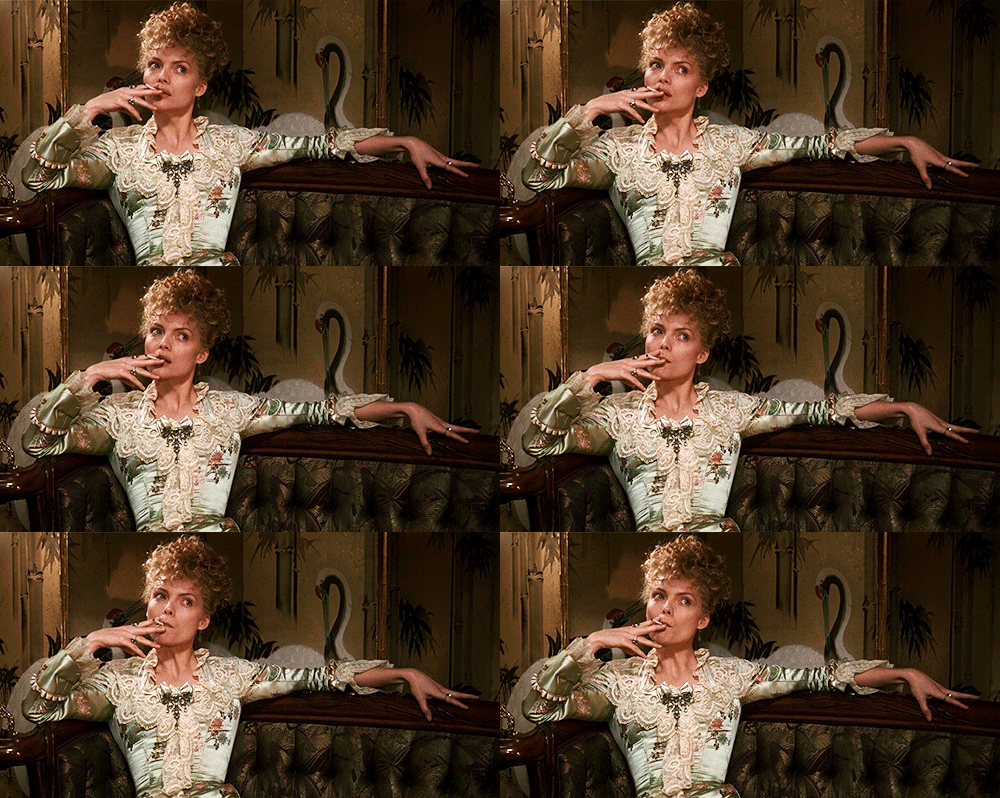
Watch: The Age of Innocence (1993, dir. Martin Scorsese). Scorsese called this his most violent film—and he meant it. There are no guns. The violence is entirely social: a raised eyebrow, a whispered reproach, the collective decision of a room to destroy someone without ever acknowledging they've done it. Michelle Pfeiffer as Ellen Olenska holds the kaleidoscope—she sees the hieroglyphics clearly, and chooses to read them aloud. Daniel Day-Lewis as Newland Archer sees the hieroglyphics too, but chooses silence and stability. Scorsese never explicitly condemns the system, choosing instead to make its inner workings transparent, one exquisite, devastating social maneuver at a time.
Listen: Caro Burke and Katie Gatti Tassin, “Jeffrey Epstein & the Ordinary Misogyny of ‘Extraordinary’ Men,” Diabolical Lies, March 8, 2026. They make the systemic justice argument: the legal system failed survivors because we assign credibility to rich men, even when they have none. This article was inspired by that pod. Genius mythology converts financial power into untouchable reputation.
Learn: Sir David Brewster invented the kaleidoscope in 1816 by accident. He was studying the polarization of light when he peered into a tube of mirrors and found it transformed reality in ways he hadn't anticipated. He named it from the Greek: kalos (beautiful) + eidos (form) + scopos (watcher). “Beautiful form watcher.” Peter Roget (of the Thesaurus) wrote in 1818 that the invention had produced a “universal mania” seizing “all classes, from the lowest to the highest.” Brewster received a patent in 1817, but a mistake in the wording made it unenforceable. Competitors copied his design immediately, flooded the market with cheap cardboard versions, and made fortunes. Thus, Brewster received the credit, but almost none of the money, cut out of the financial arrangement by people who understood the invention’s value and moved faster than he did. Brewster’s Treatise on the Kaleidoscope (1819) is in the public domain and available free online.
Next Up: Specious theories of valuation operate everywhere. Next time, we’re taking it to Chapel Hill, where a university is currently deciding what’s valuable and who gets to say so.
The Arconia is partly inspired by the Ansonia, the Upper West Side apartment building where I grew up. The Westies, a group of illegal tenants, are almost certainly inspired by our building’s extensive landlord-tenant feud. If you fact-check this, you'll find the history of a 247-day rent strike. HAHAHA—it was much, much longer than that. How do you avoid paying rent for decades? By living in an "uninhabitable" domicile. The apartment was awful, but our community was amazing.
Confused? You should be. My parents separated when I was 6, but did not divorce until I was 16. They had no formal child support arrangement during this time. My dad paid for things—school tuition, shoes, clothes, food—when he felt like it. More often that not, he didn’t feel like it.
This could sound whiny, as if I didn’t appreciate the immense privilege of my education. I loved every moment of learning at Grace Church School and Spence School. But I recognize myself in Ellen Olenska: “the real loneliness is living among all these kind people who only ask one to pretend.”
Burke and Tassin, Jeffrey Epstein & the Ordinary Misogyny of 'Extraordinary' Men
McMillan Cottom again, get used to it. “In the Name of Beauty,” in Thick: And Other Essays (The New Press, 2019)
Eliot Brown and Maureen Farrell, The Cult of We: WeWork, Adam Neumann, and the Great Startup Delusion (New York: Crown, 2021)
This is such smart analysis. I have read some where by someone in the last week an article that focused on the banal and transactional emails of the Epstein files. The 90% of emails that have nothing at all to do wth trafficking. Someday there will be a map of unremarkable exchanges between people who are only remarkable by affinity. We don't need that to know how the power worked though, and you've given us 6 ways of looking.
On another note, I have a cheap cardboard kaleidoscope on my desk--the kind that transforns whatever you're looking at through a clear marble at the end. It's a new perspective anywhere you point it and I keep it handy for when I'm stuck and need a minute to shift my view and play. I love a kaleidoscope.
Wow I loved this. It also means i need to retire my own line of why don't women get to be geniuses cause maybe we don't want the label :/