

13 Things: Abundance Grows Through Interdependence
Thirteen things I read, saw, heard, and learned while I resting.

Hi there. Took a few weeks off. Actually, I took this whole Substack down. I wrote some pretty words on Instagram about why, but it wasn’t the whole truth.1
The whole truth: I self-censored because it made a few men uncomfortable. Taking my own writing offline to manage that discomfort is the most off-brand thing I’ve ever done.
I’ve come to my senses, so let’s get back on track, shall we? 13 Things I read, saw, heard, and learned from while away from my post.
Meg Conley.
Meg Conley is my favorite writer. I don’t say that lightly or to be nice. Meg publishes Pocket Observatory, a not-for-profit attention reclamation project with no ads, no algorithms, and no AI.
Meg finished chemotherapy and radiation four weeks ago. She is back at her desk anyway, because she has wanted to be a writer since she was six years old, and that doesn’t stop for cancer.Her most recent post is called “Alright, let’s do this one last time.” Please read it, subscribe, and donate if you can. Pocket Observatory is free to every reader, but she has a tip jar and you can feel free to use it.
Here is a quick set of faves, but you can’t go wrong with anything Meg pens:
- My kid is afraid we’re in a simulation
- A pilgrimage to a Taylor Swift Shrine
- Vultures, Motherhood and the Dead (Year)
- Manifest Destiny
House of the Dragon.
I’m obsessed with this show’s demonstration of the stupidity of primogeniture and patriarchy. (It’s like reading Allison Tait, but with dragon battles.)
After the latest episode, I’m swapping out my desk Funko Pop for Alys Rivers. Alys is a witchy healer who lives at Harrenhal Castle, on the shore of the God’s Eye, the lake that holds the Isle of Faces — Avalon-shaped, if you’re paying attention — which makes her, structurally, a lady of the lake. Caitlín and John Matthews’ Ladies of the Lake argues that the Arthurian tradition couldn’t tolerate one woman holding multiple kinds of power simultaneously, so it split a powerful Celtic goddess figure into nine separate, individually diminished figures — Morgana, Guinevere, Nimue, Kundry — and assigned each a single social function to perform.
House of the Dragon has an entire cast of fascinating women struggling with fragmentation, because Westeros’ patriarchal society cannot conceive of a woman who holds a range of roles. But Alys keeps troubling categorization. She’s sorceress, advisor, lover, and witness. The refusal to be legible or predictable— that’s a kind of power I want to meditate on.
The Abundance Spell
A while back, I promised to tell you about an abundance spell I wrote. The spell grew from Tosha Silver’s It’s Not Your Money, which I encountered in a delightfully challenging book club led by Ella Palmisano and Krystle Baller.
Ingredients and Tools:
- Garden or windowboxes
- A variety of plants from cuttings (I used ivy)
- Glass bottles
- Bowl
- Pen and paper
- Soil
- Water
- Tosha Silver’s Abundance Change Me Prayer
Directions:
1. Gather your cuttings from your own plants, friends’ plants, and bought plants.
2. Propagate indoors in those glass bottles for any length of time. (I kept my ivy cuttings for three moons.)
3. While you’re propagating, write a) something you’re grateful for, b) something you want to invite in, and c) something you’re ready to shed. Every day, if you can. Keep the things you want to shed separate.
4. When you’re ready to plant, shred the papers that record your gratitude and invitations.
5. Burn the papers that record your points of release, and keep the ash.
6. Add the shredded papers to water, mixing in a clockwise direction, creating a slurry.
7. Mix slurry with your soil, mixing and mashing in a clockwise direction.
8. Then add the ash to the soil, mixing and mashing in a counterclockwise direction.
9. As you plant your garden, recite the Abundance Change Me Prayer over and over, until you’re done.
10. Visit your garden every morning, water and fertilize as needed, reciting the Abundance Change Me Prayer at least once on every visit.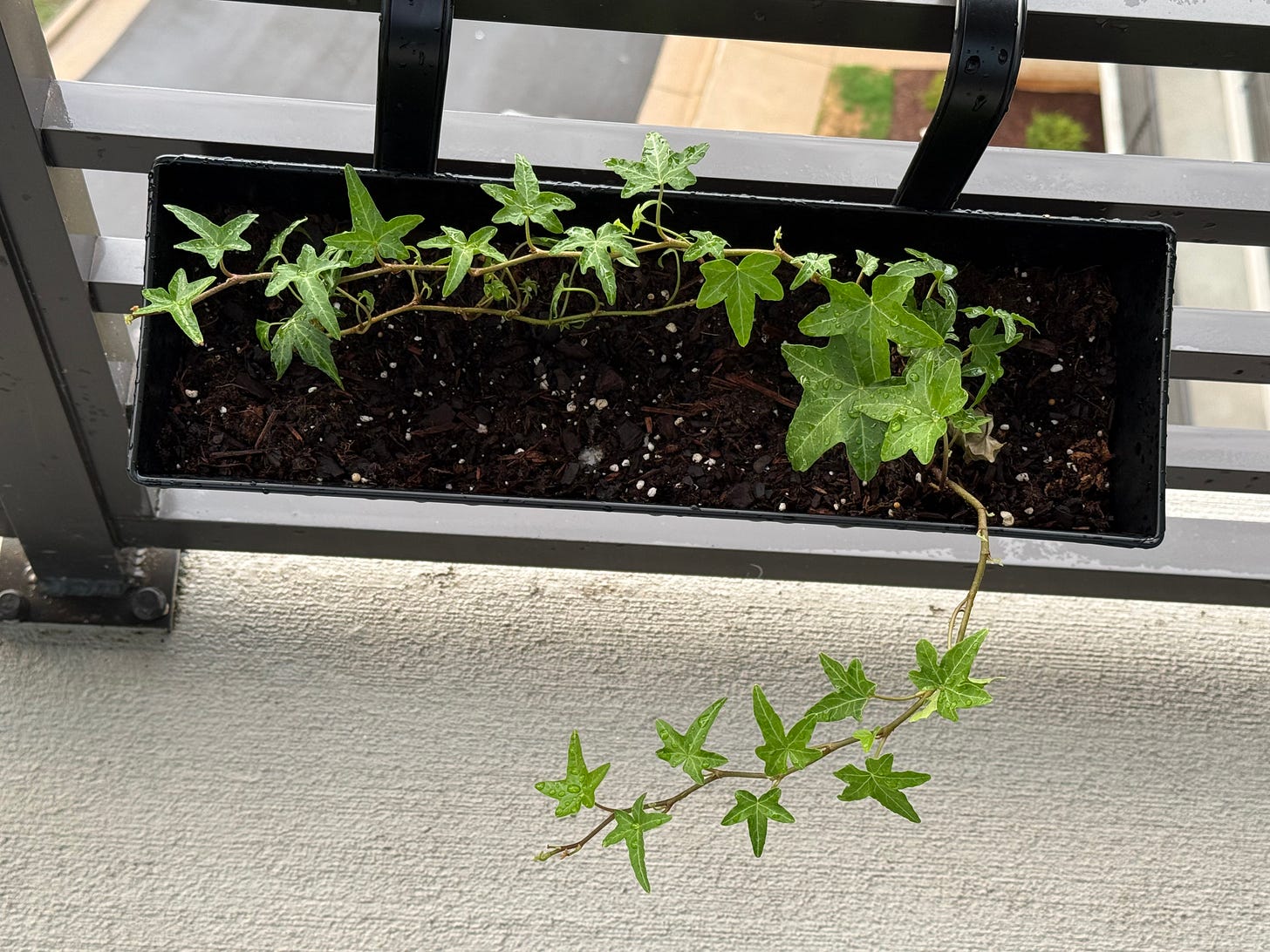
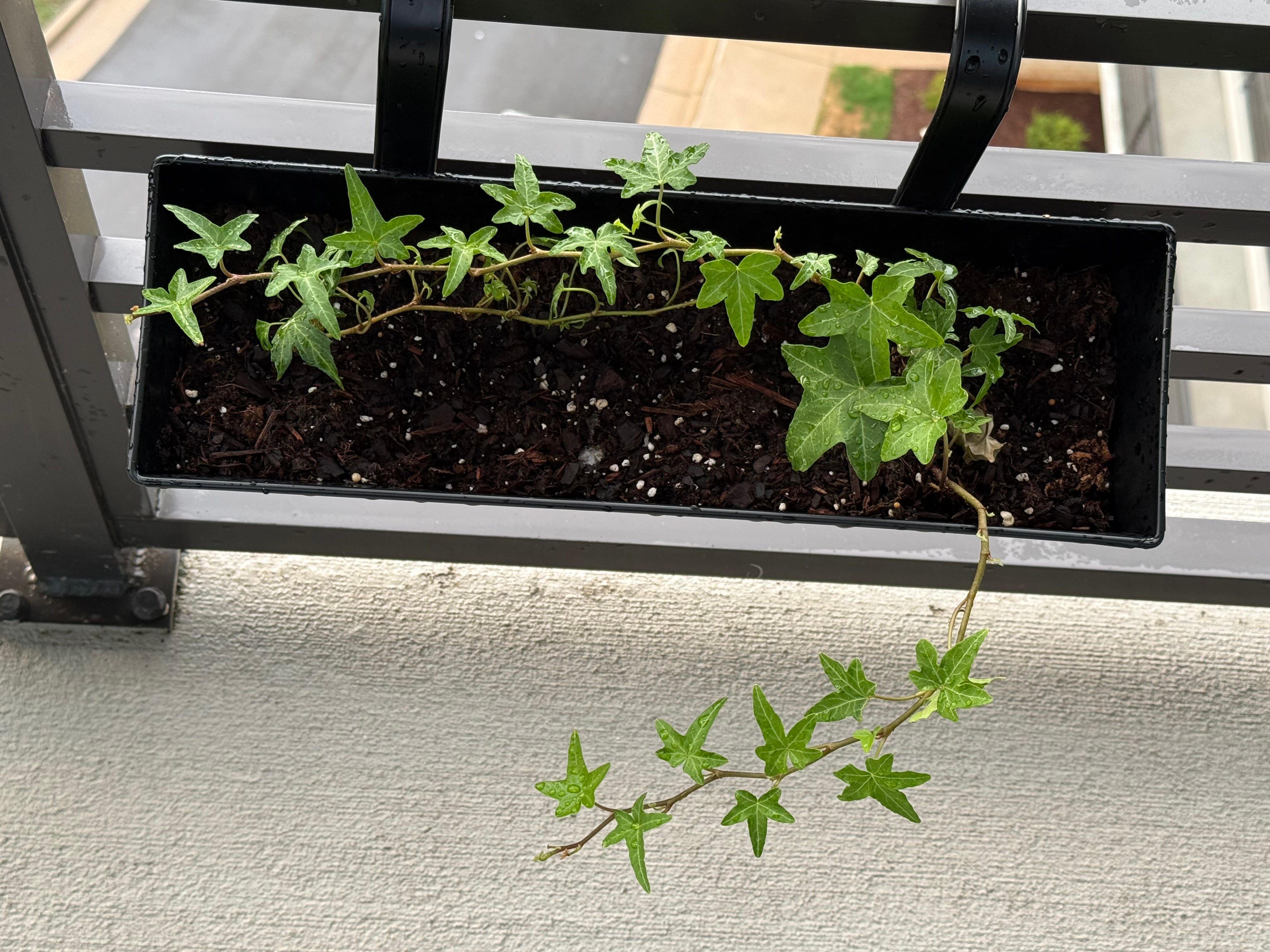
The cutting on the left (which I propagated) has intertwined with the cutting on the right (which I bought), in a verdant display of interdependence.
I didn’t have a firm outcome for this spell — the main idea was making the directives in Silver’s book an embodied practice. It’s the Abundance Change ME prayer, so the goal was to change ME in whatever way necessary.
My ivy is growing beautifully, and the learning outcome is which plants are growing. Only one of my own nursed-all-winter cuttings thrived. The rest withered away.2 However, the cuttings sourced from others — they’re all growing rapidly, bending around the rails of my deck as they spread towards the sun.
The magical insight is that abundance grows through interdependence.3 If I’d relied on my own cuttings, if I’d believed I could grow the garden all by myself, I’d be severely disappointed. How is this changing me? It’s helping me integrate the understanding that I can’t, and shouldn’t, try to create abundance on my own. When I’m open to receive, when I can allow some things to die in order to make space for others, then I’m allowing the strongest opportunities to flourish. Whether I get full “credit” for them or not. By allowing others to give to me, and caring for the gifts they offer, my role is right-sized, and I’m not exhausted. And I’ll have something to pass on.
If you want some ivy cuttings, let me know. ;)Negging and Backhanded Compliments
I’ve been thinking about negging — the use of backhanded compliments or mild insults to undermine someone’s self-esteem, often in the service of making them more receptive to sexual advances — a lot. I’m endlessly fascinated by the way romantic and family communication models pop up in professional negotiations, and I’ve been seeing this one all over my emails this year. Want some guidance on how to respond to negging in professional contexts? Read about Trolls, Bullies, and Bad Doms.
Reverberations: Lineages in Design History
Brian Johnson is a partner at Polymode and a member of the Monacan Indian Nation, born into a family of printers. He’s also my client and my friend.
Polymode designed the companion catalogue for Reverberations: Lineages in Design History at the Ford Foundation Gallery, co-curated by Brian and Silas Munro and curatorial advisors Randa Hadi, Lisa Maione, and Ramon Tejada. The book traces BIPOC design lineages across generations — work buried, work renamed, work absorbed into movements without the artist’s name attached — and connects these lineages forward to now. The cover pulls from the exhibition’s iridescent foil entryway; inside, the typography and pacing do what the show’s central metaphor demands. Reverberation, as sound and as shared inheritance.
Internally, my head is a great web of nodes. I think of credit or appropriation as the strands between the nodes. Brian has a web, too — some of his nodes and strands are different, but some are the same. When we talk, and he hits a node, it’s like a whole new song plays in my head.
Reading Reverberations is like having a conversation with Brian — fundamentally, it’s just a great time, but it’s also like having a new songwriter in your head, and he’s remixing everything you know in the most engaging ways.
My dream house is on the market. Furnished. Jessica Helgerson and Mira Eng-Goetz spent five years working on this, and I can’t imagine what would induce the owners to give it up. (I hope everything is OK, and not in a concern-troll way. Some people are rich enough to get bored by this sort of project, but I’m not one of them. I’d die here.)

3360 SE Ankeny St., Portland, OR 97214

Back To Basics
I’m taking my daughter to her first yoga class today — a private 101. I’m re-reading Examples and Explanations for Intellectual Property. I’m reviewing recipes carefully and setting out my mise en place before I begin. I’m sitting in on USPTO webinars. I’m checking my grammar in Strunk and White. This summer, there is something nice about doing the foundational work carefully, and I’m experiencing high-level insights from re-engaging with low-level resources.
Atalanta
I’ve been listening to Jean Shinoda Bolen’s books while rage-cleaning my house. (Y’all, my house is SO clean. You could eat off the floor.)4 In Greek mythology, Atalanta is a legendary huntress abandoned at birth and raised by a bear, who distinguishes herself by outperforming a bunch of dudes in the Calydonian Boar hunt. After Atalanta becomes famous for her athletic prowess, the father who abandoned her reclaims her — and forces her to marry. She agrees to comply, but only if the suitor can outrun her in a footrace. Any man she beats is executed. (Very Brave, but the boys don’t become her buddies, they lose their heads.) Instead of praying to the gods to defeat Atalanta, suitor Hippomenes prays to Aphrodite for his intended’s love and esteem. Aphrodite gives Hippomenes three golden apples, which he tosses into Atalanta’s path as they race. Overcome by the apples’ beauty, Atalanta pauses to retrieve the fruit, allowing Hippomenes to win.
Bolen reads the apples not as a trick but as an invitation — each one an archetypal energy that Atalanta’s ferocious single-mindedness had left unclaimed. The first apple is Aphrodite’s intimacy and vulnerability — the choice to love someone without losing yourself in the process. The second is Demeter’s community and caregiving — the recognition that other people’s flourishing is also yours. The third is Athena/Hestia’s blend of wisdom and home — the realization that there is something worth stopping for. Bolen’s ultimate point is that Hippomenes’ love helped Atalanta live a rich, relational, and fully human life. If Atalanta had won every race, she would have remained a one-dimensional archetype — forever running, isolated, and defensive. Slowing down to pick up the apples is what allows her to become a whole, multi-faceted person. Atalanta doesn’t lose the race. She chooses, for the first time, to want something else. I really love that.
I bought VIP tickets for my teenage singer-songwriter, which you could deem a birthday splurge or a history lesson. I was exactly the right age for Lilith Fair and can’t understand why I didn’t go. Perhaps because my own mother was very anti-music-festival (for safety reasons) and I was very anti-port-a-potty (for prissy reasons). Anyway, can’t fix that, but I can make sure my daughter doesn’t miss out on this era of musical collaboration. (Also: Frontgate created a low-stress purchase experience, proving that Ticketmaster is hell on purpose.)
“Widow’s Bay” Sets a High Bar for Horror Comedy
It’s mesmerizingly great. If you’d like a more articulate take, read what Guillermo del Toro (!!) said about it:“If I may — in my estimation — “Widow’s Bay” may very well be the best streaming series in a long time ... and hands down one of the most mesmerizing acts of narrative prestidigitation in Horror.”
Or read The New Yorker’s review, which convinced me that this was THE show for a visual-studies-loving mom and true-crime-loving-daughter.
Quince’s new summer color is the prettiest. Cate Linden5 once explained that this color is my version of black — as in, it should be the base of my wardrobe — and I’m so happy to find it produced here in every basic article I could desire. (Plus some not-so-basic articles.)
White Peaches, Brown Sugar, Vanilla Gelato, and Basil
A friend and I were discussing the nature of creative lulls and depressive periods, Audre Lorde’s “Uses of the Erotic,” and Freudian theory. So, I shared a weird thing I’ve been doing since sixth grade to make my creative juices flow — I make lists of things I like. It’s so simple, and kind of dumb, but it works so well.
You just start listing. Sheets right from the dryer. Oak trees. Petrichor. Puppy bellies. The Row’s brand icon. Once you get going, your mind starts branching off in new directions: “I like Chappell Roan. Drag brunch. Sequins and tulle on costumes. Applying sequins to anything, really. Cat Babbie’s The Science of Preciousness. My conversation with Jason Lord about found materials.” And then your brain will go, “Wait, Jason Lord is doing The Ministry of Cardboard at Scrap Exchange. Why am I sitting here?”6
This practice is also great for summer eating, because you’ll write “White peaches.” Then you’ll remember that white peaches are excellent broiled with dark brown sugar. Vanilla bean gelato will improve that. A sprinkling of julienned basil for a verdant kick. Eating a peach might not feel creative, but a broiled, herbaceous sundae is, and now you’re being creative.
“When women suppress their rage, abusers benefit.”
As my therapist tells me: fawn, freeze, flight, and fight are a spectrum, and fight is at the top of the spectrum, closest to present and awake.
From Maria Cassano’s excellent call-to-crazy:
Female rage is an extremely effective survival strategy because it doesn’t seek to overpower men’s bodies. Rather, it short-circuits their brains.Evolutionarily, we’re conditioned to fear erratic behavior, which signals danger: A leopard’s sudden lunge. The hiss of a rattlesnake’s tail. A tarantula’s frenzied scurry. These cues shock our brains into panic mode, so when a woman goes feral on a man, he suddenly feels like the victim…
What if we stopped keeping the peace?What if we quit apologizing for basic human emotions?
What if we met harassment with shrill voices and wild eyes?This culture has conditioned us to be soft, sweet, and small, and it’s turned us into prey. Maybe it’s time we held a mirror up to our predators.
Don’t hold yourself tightly. Don’t shrink or scurry. Don’t rush past. Stare back. Bare your teeth. Scream.7

Next Up: In July, I really would like to sit on more porches and pet more puppies. I can’t produce insight on a weekly schedule—my Human Design chart says so, and that guidance is working so well, I’m loath to ignore it. (Curious now? Go find yours.)
So, a few changes:
- Paid subscriptions are turned off.
- I’ll keep sending 13 Things every Friday — it’s such a pleasure to connect with all of you via email, in meetings, or over coffee to talk about things we’re reading/seeing/hearing together. Just not this Friday, because it’s my partner’s birthday.
- I’ll send Essays (the long ones) and Correspondences (the short ones) when I’ve got something to say.
Tell me your Human Design type. I am obsessed. 👇👇👇
I mean, I do want to sit on more porches and drink more martinis, but maybe rest is conducive to writing, not in competition with writing.
My beloved grandfather was a horticulturist, so I understand and deeply respect the science behind cutting survival rate. Science is not the point here.
Big hug to my new friend Bonnie, who put this more succinctly than I could alone. Again, it’s better with friends.
I’m still working through the incident at the center of Dream Girl Evil.
Time with stylist Cate Linden was my 40th birthday present to myself. I could talk all day about how much I love Cate. She is brilliant at her job — whether that’s styling you for a single shoot or overhauling your entire look. She’s kind, wise, and flexible, and will never make you feel bad about yourself. She’s also saved me a ton of money, because I now understand only 3% of clothes online will look good on me. I also wear everything in my closet.
This may work best for those of you with ADHD.
And if no one is around to scream at, clean your house until you can eat sushi off any surface!
I’m so glad you’re back! Adair was Atalanta for Halloween when she was 8. I’m going to read this to her when she’s back from camp! Also, definitely doing this spell. Manifesting Generator over here. 🙋🏻♀️
Your back to basics sound lovely. Do you have the illustrated Strunk & White book? It’s fun.
And I had to scroll past the House of the Dragon because I haven’t had a chance to watch yet. Alas!
And welcome back!